Emirates Shipping Association
The Human Factor: Maritime Mental Health in a Time of Crisis


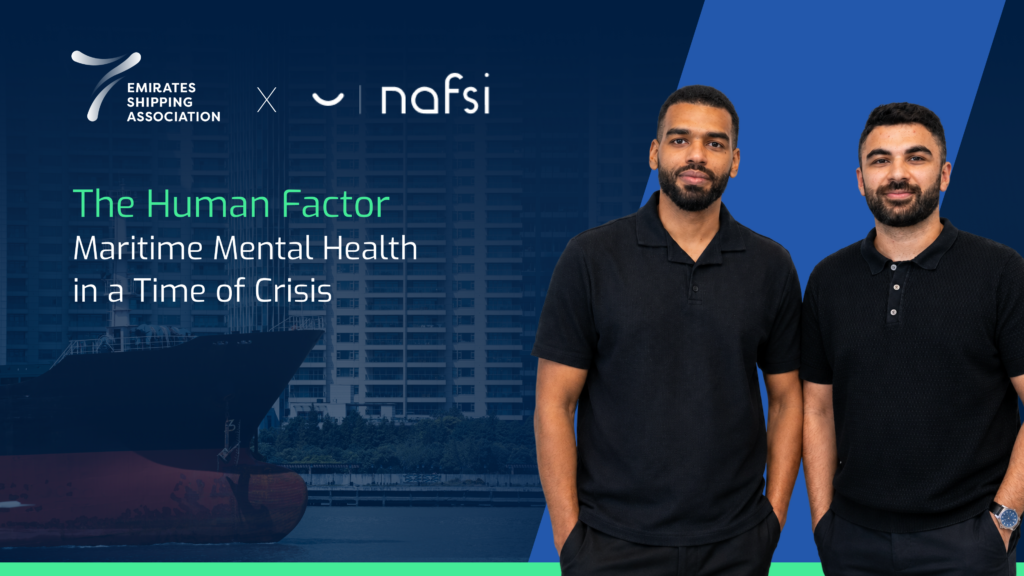
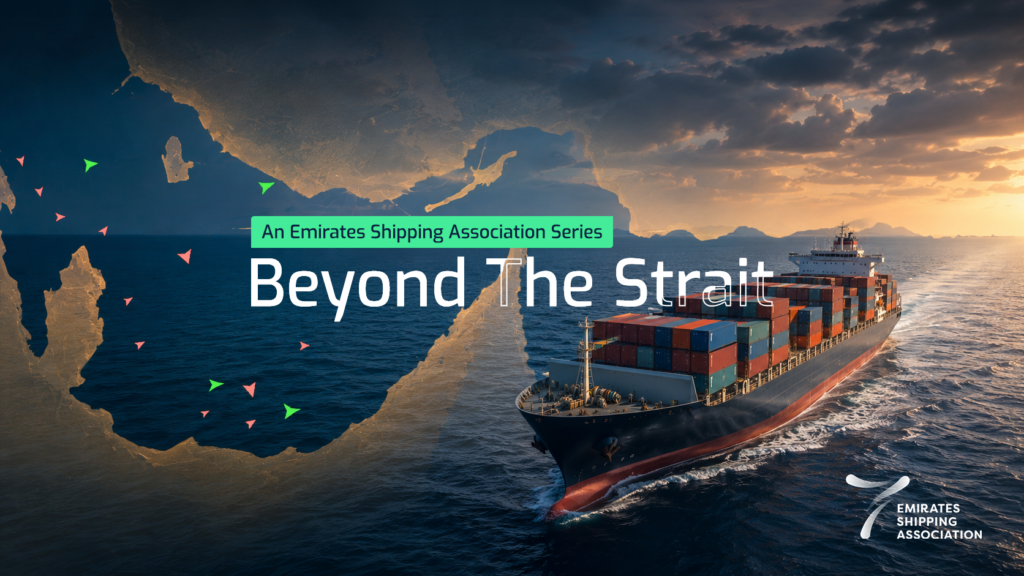
This article is part of Beyond the Strait — a thought leadership series from Emirates Shipping Association exploring the dimensions of the recent Arabian Gulf disruption. The series covers five themes: Human Factors, Legal, Insurance, Operational, and Commercial.
For 33 kilometres of water, the world’s attention turned to the Strait of Hormuz. Tanker rates broke records. Insurance markets adjusted. Container lines rerouted via the Cape of Good Hope. The economic and operational consequences were charted in detail by analysts, governments, and the maritime press.
Alongside those numbers is another story worth telling — the story of the people who kept the industry moving through the disruption, and what their experience has shown about how far maritime mental health support has come.
Every stranded vessel had a crew navigating unusual circumstances. Families ashore waited for updates. Shore-based teams in the UAE managed operations under significant pressure. And through it all, welfare systems, employer support, and industry-wide collaboration held up in ways that reflect real progress over the past several years.
This article focuses on that human dimension — the mental health of seafarers and the wider maritime workforce, what the past four months have illustrated, and where the industry is heading.
As the situation continues to evolve, this article reflects publicly available information, original research from Nafsi Health, and expert insight gathered as of June 2026.
A Profession That Requires Focused Support
Seafaring has always been a demanding profession. What is changing is how well the industry understands that — and how it is responding.
1 in 4 seafarers in the region is affected by depression, anxiety, stress, or a mental health issue — a rate higher than in the general population.
Research by Nafsi Health, in partnership with a UAE-based academic institution, has examined the mental wellbeing of seafarers operating in and around the Arabian Gulf. The findings reinforce what the welfare community has understood for some time: seafaring is one of the professions where focused mental health support has the greatest value.
“Seafarers were by far the number one industry at risk of mental health issues. Think about all the other industries — firefighters, ambulance workers, first aid responders who see a lot of things every day. Yet seafarers were by far, and it wasn’t even close, the most at risk of developing mental health issues.”
— Tayeb Hassan, Co-Founder, Nafsi Health
Several factors combine to make seafaring uniquely challenging. Months at sea away from family. A working environment that is also the only living environment. Limited access to traditional mental health support. And the cumulative experience of events including the COVID-19 crew change period, the Red Sea incidents, and now the disruption in the Arabian Gulf.
Research into seafarer mental health has grown by approximately 50 per cent since the pandemic — a sign of how quickly the industry’s understanding has developed. That momentum is likely to continue.
What Prolonged Uncertainty Means in Practice
The clinical evidence on prolonged stress is well established. Sleep deteriorates. Cognition narrows. Decision-making slows. Motivation drops. The body remains in a heightened state of alert long after the immediate pressure has passed.
For seafarers operating under months of uncertainty in the Arabian Gulf, these dynamics were not abstract.
“People were genuinely scared. There was a lot of uncertainty, and they were not really sure how to tackle this — not just for themselves, but trying to understand how to explain it to family members abroad who might be worried, trying to figure out how to explain it to your kids. How do I tell a child that everything is going to be okay?”
— Muhammad Ali Ilyas, Clinical Psychologist, Nafsi Health
One of the most useful clinical insights is how organisations should interpret what they observe. A natural dip in output during a sustained crisis is not a failure of resilience. It is a predictable human response to an extraordinary situation — and one that can be managed effectively when understood.
“An abnormal reaction to an abnormal situation is a normal reaction.”
This framing matters because it changes how organisations respond. Companies that recognise stress as an expected part of a difficult moment are able to support their people effectively. That understanding is now increasingly standard across the industry.
A Growing Recognition of Mental Health as a Core Priority
In operationally heavy industries, mental health has historically been treated as a secondary concern. That view is changing quickly.
$1 trillion is the estimated annual global cost to corporates of ignoring workforce mental wellbeing.
The business case is well established. Research consistently shows that companies investing in workforce mental wellbeing see meaningful improvements in productivity, retention, and operational performance. In dispersed, mobile workforces — the kind maritime depends on — those gains are amplified.
“Good mental health can determine whether someone is able to properly carry out their duty. It is also an issue of safeguarding, because if someone is in the best state of mind, we know that we would have the least errors on board in any ship.”
— Muhammad Ali Ilyas
The link between mental wellbeing and operational safety is direct. In an industry where clear judgement and situational awareness matter, the human factor is a core operational input — and increasingly recognised as such.
What the Past Four Months Illustrated
For many UAE companies, the past four months marked a positive turning point in how mental health is prioritised.
“What we specifically saw is mental wellbeing and mental health and mental health safety became a priority for a lot of the companies, while before it felt more like a luxury.”
— Tayeb Hassan
Companies whose vessels operated in heightened-risk zones, or whose shore-based teams managed operations under pressure, moved quickly to strengthen support. Demand for services grew — crisis hotlines, peer support training, family counselling — and providers across the region responded.
Many organisations invested actively during the period. Workshops were commissioned. Confidential helplines were established. Mental health first aid training was rolled out to shore-based teams so supervisors and HR staff could recognise and respond to early signs of distress. Couple therapy was made available on board for seafarers whose marriages were strained by extended absence.
This is progress — and much of it is now embedded in how the region’s maritime employers think about workforce support going forward.
The Workforce Picture: An Opportunity as Much as a Challenge
The maritime industry is already facing a structural shortage of qualified seafarers. Globally, the projected shortfall in officers is well documented. In the UAE, the picture is broadly similar.
The recent disruption has reinforced a conversation that was already underway: how the industry can position seafaring as a strong, supported career for the next generation.
“First-generation seafarers are actually pushing their kids away from the industry. The people that have lived through it and benefited from the values they got back then are now not pushing their own kids towards it. Of course, that will lead to a continuous shortage.”
— Tayeb Hassan
The opportunity is significant. The industry knows what draws people to difficult but rewarding roles: fair pay, strong working conditions, and — increasingly — a clear signal from employers that wellbeing is treated as core business.
“Trust is not built in times of crisis. Trust is built in times of comfort — because it’s not really possible to build a skill when you’re in a state of crisis.”
— Muhammad Ali Ilyas
Companies that have invested in that trust before a crisis are now seeing the benefits, and their example is helping shape how the wider industry thinks about workforce investment.
A Structured Recovery
The reopening of the Strait is the start of a recovery phase, not the end of the story. Prolonged stress leaves a footprint, and how organisations manage the recovery period matters as much as how they managed the disruption itself.
“We can’t just continue operationally in any industry, but especially in maritime, which was very high-risk during this entire scenario. Instead, we need stages of returning to normalcy for the crew, because when they’ve been in that state for months and months, the stress that’s been held in their body for a very long time doesn’t just go away.”
— Muhammad Ali Ilyas
A staged return to normal operations is a well-established practice in high-performing industries. Crews returning from extended high-risk operations benefit from debriefing, time to reset, and structured reintegration. Fatigue audits, mental health checks, and welfare reviews — all standard in aviation — are increasingly being adopted in maritime, and the recent disruption is likely to accelerate that adoption.
Building Support Before the Next Test
Perhaps the most useful takeaway from the past four months is that support systems work best when they are built in advance.
Mental health infrastructure is most effective when it is part of the operational fabric of an organisation — training shore-based teams in mental health first aid, embedding confidential third-party helplines that staff can access without concern for their careers, conducting regular welfare audits, and ensuring that families ashore are part of the support ecosystem.
For dispersed, mobile workforces, digital infrastructure has a particular role to play. Internet access on vessels is improving across the industry, opening up new possibilities: one-on-one therapy sessions, structured assessments, multilingual coping resources, and crisis support available directly to seafarers who might otherwise be out of reach. Couple therapy, family counselling, and peer support can now happen mid-voyage in ways that were not possible even five years ago.
Aviation is often cited as a helpful benchmark — an industry that recognised human factors as operational factors and integrated support accordingly. Maritime is now well-positioned to make similar progress, building on the work already underway.
The spotlight of recent months has fallen on the Arabian Gulf, but the human dimension of seafaring extends well beyond it.
“While this crisis has put a spotlight on the lives of seafarers and how difficult it is, the spotlight is primarily on the Arabian Gulf. But there are thousands of other seafarers that are still isolated, continuing to go from Brazil to China, from America to China, that weren’t in the Arabian Gulf, that are still going through the issues they had before. We hope that we understand that seafarers are human beings, and not just carriers of whatever the ship is carrying.”
— Tayeb Hassan
It is a useful perspective as the industry moves into recovery: the systems being strengthened in response to this disruption stand to benefit seafarers on every route, not only those that made the headlines.
In Closing
The Arabian Gulf disruption tested every part of the global maritime system. Ports remained operational. Commercial systems adjusted. Insurance markets responded. And the welfare infrastructure — built up steadily over recent years — held under pressure.
The broader lesson is a positive one. Maritime resilience is built on people, and the industry now has a clearer picture than ever of what its workforce needs. Companies and jurisdictions that continue to invest in that resilience will be well-positioned for whatever comes next.
The recovery phase now underway is an opportunity to apply what has been learned and build on the progress already made. As operations return to normal, the focus shifts to sustaining that momentum — and continuing to strengthen the systems that support the people who keep maritime moving.
Press Enquiries
For media enquiries, interview requests or further information on this topic, the Association's communications team is available to assist.