Emirates Shipping Association
The Human Factor: A View from the Helpline


This article is part of Beyond the Strait — a thought leadership series from Emirates Shipping Association exploring the dimensions of the recent Arabian Gulf disruption. The series covers five themes: Human Factors, Legal, Insurance, Operational, and Commercial.
When the Strait of Hormuz disruption began on 28 February 2026, calls to ISWAN’s SeafarerHelp helpline increased almost immediately. They came from seafarers approaching the conflict zone, from crews operating inside it, and from families ashore.
Over the four months that followed, the helpline became one of the most direct sources of information on how the disruption was affecting the maritime workforce. While the maritime press tracked vessels and freight rates, ISWAN tracked the human dimension — call by call.
The story it tells is not only one of pressure under unusual conditions. It is also one of resilience, of welfare systems that worked, and of an industry that has a clearer picture than ever of what its workforce needs.
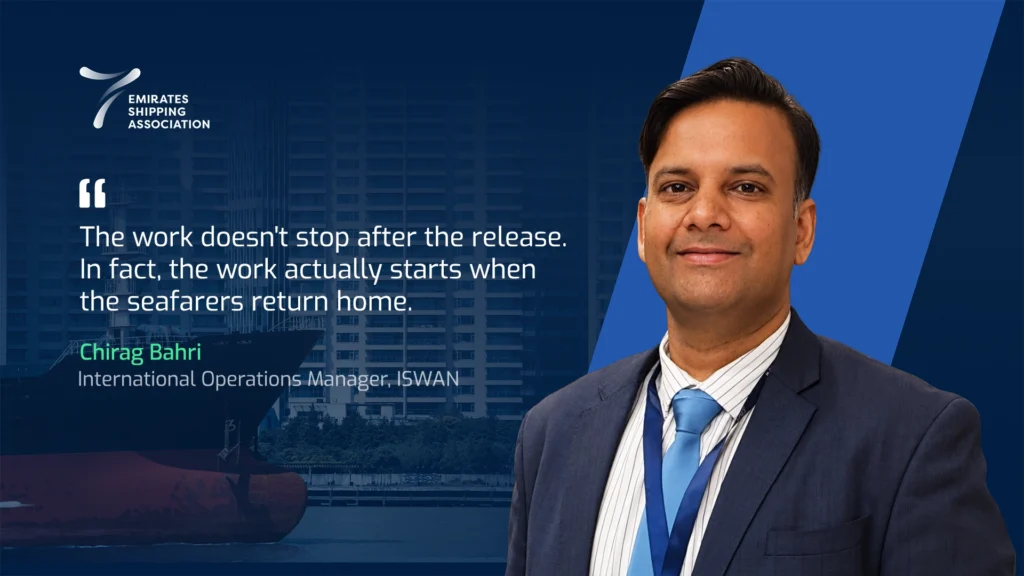
This article draws on a conversation with Chirag Bahri, International Operations Manager at the International Seafarers’ Welfare and Assistance Network (ISWAN), and a former seafarer.
The Helpline’s Role
ISWAN runs a confidential, multilingual helpline that operates twenty-four hours a day across direct call, WhatsApp, live chat, and other platforms. It is available to seafarers and their families, and it has remained available throughout the disruption — a steady presence in a period when other forms of support were under strain.
When asked who has been calling over the past four months, Chirag’s answer is clear.
“Seafarers were very tired and worried about what is going to happen to them when their ships were about to reach the conflict zone, and some of them were inside the conflict zone. They had no idea what is to be done, how they can repatriate and what are their rights. We also saw families of the seafarers contacting us because they were very worried — they had not been able to return home. They were very much fearful about what is going to happen to my seafarer and how will they come home.”
— Chirag Bahri, International Operations Manager, ISWAN
The helpline volume increased over the course of the disruption. The pattern was familiar to ISWAN — broadly similar to other recent maritime crises including COVID-19 and the Red Sea incidents — and the team was well-prepared to respond.
One notable feature of the Arabian Gulf disruption was the speed at which uncertainty moved through informal channels. Crews received conflicting messages from different departments of the same shipping company. Information about route closures and incidents was sometimes reaching vessels via social media before official sources. Families ashore were hearing reports that contradicted earlier communication from companies.
The experience has highlighted a clear and addressable priority for the industry: strengthening direct, consistent communication between companies, crews, and families during periods of disruption.
The Impact of Prolonged Uncertainty
The clinical understanding of prolonged stress is well documented. Chirag describes the patterns ISWAN has observed through helpline calls.
“Seafarers have actually shown signs of demotivation, a loss of confidence in the leadership team, frustration and helplessness. Crew members feel trapped, leading to an increase in stress and anxiety levels. It can also impact the crew cohesion on board. Their sleep cycles have been impacted as well — because they have been having prolonged watchkeeping and are not able to look after themselves well. That also impacts the overall decision-making capacity, and the fatigue has been increasing.”
The pathway from psychological stress to operational risk is well established. Disrupted sleep affects concentration, which affects decision-making and reaction time. In maritime operations, where margins for error are narrow, crew welfare is directly linked to safety performance.
The good news is that these patterns are increasingly well understood, and the support frameworks to address them are more mature than they were even a few years ago.
Families ashore experience the disruption in their own way. Delayed sign-offs (the formal end of a seafarer’s contract and return home), conflicting information, and limited contact with loved ones at sea all contribute to elevated stress. ISWAN’s data indicates that in extended crises, family calls account for a meaningful share of helpline volume — a sign that the welfare ecosystem now extends beyond the vessel to the home, which is a positive evolution in how the industry supports its workforce.
Lessons from a Personal Experience
Chirag’s perspective draws on his own experience at sea.
“I was held in captivity in Somalia for about eight months in the year 2010. And that changed the course of my career altogether.”
That experience led directly to his work supporting seafarers and their families through the most difficult moments of their careers. When asked what the reopening of the Strait will mean for the seafarers who lived through the Gulf disruption, his answer draws directly from his own release.
“When we were released from captivity in Somalia, there was a lot of fear and uncertainty. What will happen next? Whether the next group of pirates are going to be boarding my vessel? How will I be able to reach the next destination — the safe destination or not? Those questions were there in our immediate mind, and we were not fully fit. We had a lot of mental stress in the back of our mind. It was a very tough time to stay connected with our families as well, because we were actually very fearful about our own personal survival.”
This experience informs one of his most useful observations for the industry: the end of a crisis is not the end of its operational impact, and the recovery phase is where focused support has the biggest return.
For seafarers returning from extended high-risk operations, the period immediately following the resolution requires careful management. Recovery is not the same as returning to normal operations. With structured reintegration, crews can rebuild routines confidently — and the industry can reduce the risk of accidents that often follow major disruptions.
“The reopening may create false confidence as well, leading to shortcuts in safety checks and reduced vigilance among the crew members. Human behaviour and culture shape the risk that materialises from here. A fatigued crew from a culture that discourages speaking up may silently comply with unsafe orders. Conversely, culturally sensitive leadership can foster resilience, trust, and safer operations during the transition.”
The opportunity here is significant. Companies that handle reintegration well will see stronger crew retention, lower incident rates, and a workforce that returns to operations more capable than before.
What Companies Can Do
The most immediate practical step shipping companies can take for their crews is straightforward.
“The most important thing is the assurance from the shipping company that ‘I am going to be there with you in the crisis time, and I am going to help you come out of this crisis as well.’ Open communication between the seafarers and the shipping companies — and whatever monetary assistance the companies could provide as a goodwill to the seafarers — they should definitely consider that. Reintegration of seafarers is extremely important and crucial.”
Companies that have invested in seafarer-centred policies before a crisis are generally better positioned to manage one. Many UAE operators have responded to the recent disruption with practical, well-judged support for their crews — strengthening trust and setting a strong example for the wider region.
Practical interventions in the post-crisis period include:
- Clear seafarer-centred standard operating procedures
- Accessible counselling support for both seafarers and their families
- Structured debriefs and reintegration time before returning to standard operations
- Continued welfare and financial support during the recovery period
Chirag emphasises that the ISWAN helpline remains available throughout this period for any seafarer or family that needs it, regardless of company affiliation or nationality.
The Workforce Picture
Maritime is already experiencing a structural shortage of qualified seafarers. The BIMCO and ICS Seafarer Workforce Report has projected significant officer shortfalls in the coming years. The recent disruption is not the cause of that shortage, but it has surfaced a useful conversation about how the industry can become a more attractive long-term career.
ISWAN’s surveys during the COVID crew change crisis indicated that a meaningful share of seafarers were questioning whether to remain in the industry. Long contract extensions, repatriation difficulties, and limited support during that period shaped how many seafarers viewed the career.
“A lot of seafarers at that time mentioned that they would like to actually pursue some other careers — not shipping. We need to ensure that crew welfare must be treated as central to resilience, and not secondary to commercial operations. We totally understand that ships are meant to operate, and companies need to do the business to be able to support seafarers — but we would need to ensure that all our policies, all our infrastructure, whatever we are developing, needs to have the seafarers at the centre of it.”
The encouraging shift since then is that the industry has moved significantly in this direction. More companies are investing in welfare. More frameworks exist to support seafarers and their families. The recent disruption has reinforced the case for that direction of travel.
Chirag identifies several structural priorities for the industry: transparent communications, institutionalised crisis management systems, and culturally sensitive mental health support — all areas where progress is already underway across the UAE and the wider region.
“If the companies are able to demonstrate that they are there with seafarers when they are released back, and during reintegration support as well, I am sure most of the seafarers will see that the companies are doing everything possible to support them — and they will rejoin after a bit of time, when they can reintegrate with their families and get the support at home.”
Abandonment
Chirag also highlights an ongoing industry issue that he believes deserves continued attention.
“It is also important to look into the issues of abandonment of seafarers in the region. Unfortunately, a lot of ships and seafarers are abandoned in the region, and we have to collaborate together to address the root causes of abandonment. Unless we work together on these aspects, we can keep talking on different platforms about how to make shipping an attractive workforce — but seafarers will still feel uneasy doing their proper jobs.”
Abandonment in maritime refers to seafarers left on board vessels without pay, supplies, crew change, or means to return home, after their employer ceases operations or walks away from contractual obligations.
The good news is that the IMO, the ILO, and welfare organisations including ISWAN maintain established frameworks for handling abandonment cases, and the industry has made meaningful progress on prevention. Continued collaboration between regulators, owners, and welfare organisations remains an important priority going forward.
Reflecting on Day of the Seafarer
Day of the Seafarer, marked annually on 25 June, fell in the same week as the reopening of the Strait. The timing made this year’s theme — Carrying the World’s Trade, Carrying the Risk — particularly resonant.
The day was an opportunity for the global maritime community to recognise the seafarers who kept trade moving through one of the most testing periods of recent years. It was also a moment to reflect on what the industry has learned and where it is heading.
“We have to ensure that this industry is resilient, and we have to also make sure that we create the environment among new joiners that they feel supported, and they would love to come into shipping, and they will be the brand ambassadors for shipping worldwide.”
Building a strong pipeline of new seafarers requires the industry to be visibly supportive of the workforce it depends on. The decisions being made now — about communication, welfare, and post-crisis support — will shape how the next generation views maritime careers, and there is real momentum in the right direction.
In Closing
The Arabian Gulf disruption tested multiple parts of the maritime system. Port infrastructure remained operational. Commercial systems adjusted. Insurance markets responded. The human dimension — supported by organisations including ISWAN, Nafsi, and others across the welfare community — held under significant strain and demonstrated the value of the welfare infrastructure that has been built up over the past several years.
The four months of disruption underlined the importance of human-factor infrastructure as part of broader maritime resilience. The recovery phase now underway is an opportunity for the industry to apply what has been learned, build on the progress already made, and continue strengthening the systems that support its workforce.
As operations return to normal, the focus shifts to ensuring the lessons of the past four months inform how the industry supports its people going forward — and on the encouraging signs that the maritime sector is moving in the right direction.
Watch Chirag Bahri’s full interview here:

Press Enquiries
For media enquiries, interview requests or further information on this topic, the Association's communications team is available to assist.