Emirates Shipping Association
Member Advisory Update: Maritime Operations in the Gulf Region (31 March 2026)


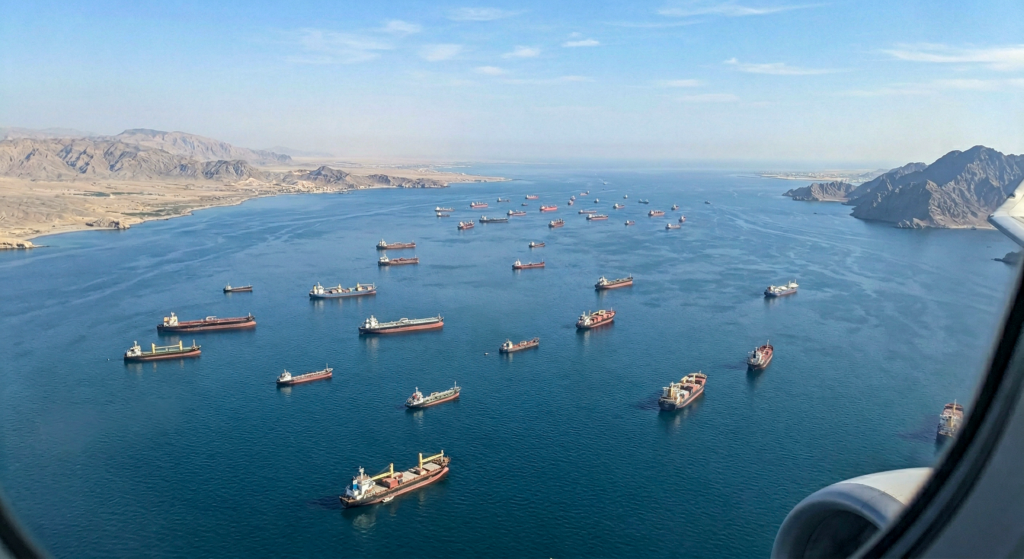
More than one month has passed since the conflict began on 28 February. The Strait of Hormuz remains effectively closed to routine commercial shipping, with a selective, permission-based transit system now in operation. Approximately 3,200 vessels are now stranded in the Gulf. The impact on global energy markets, supply chains, and consumers worldwide continues to deepen.
This advisory updates and supersedes our Member Advisory of 15 March 2026, providing the latest verified information on the maritime operating environment, the status of UAE ports, and guidance for members.
Situational Update
The JMIC threat level remains at CRITICAL. The US expects the war to last another two to four weeks, according to remarks by Secretary of State Marco Rubio to G7 foreign ministers on 27 March.
Iran has formalised a permission-based transit system through the Strait of Hormuz. In a 22 March letter to the IMO’s 176 member states, Iran stated that “non-hostile” vessels may transit “in coordination with the competent Iranian authorities,” provided they do not participate in or support acts of aggression against Iran. On 27 March, the IRGC announced that the Strait is closed to any vessel going “to and from” the ports of the US, Israel, and their allies. Vessels seeking transit must apply for pre-approval through the IRGC, broadcast an assigned code on VHF Channel 16, and in some cases follow a route through Iranian territorial waters near Bandar Abbas. Some vessels have reportedly paid fees for passage.
Since the start of the conflict, traffic through the Strait has dropped by approximately 97%. Between 1 and 31 March, Kpler data recorded just 201 commodity carrier crossings through the Strait — a 95% reduction from the pre-conflict average of approximately 135 transits per day. Ships that have transited have been largely linked to Chinese, Indian, Pakistani, or Gulf state owners.
The UAE has taken a leading role in advocating for the restoration of freedom of navigation, informing allies of its willingness to participate in a multinational maritime task force to defend the Strait and escort commercial shipping. The Association continues its engagement with the UAE Ministry of Energy and Infrastructure and relevant authorities on measures to address current challenges, including insurance and routing arrangements.
France has engaged approximately 35 countries on a possible post-conflict mission, while the UK is coordinating with US Central Command. India has deployed warships under Operation Urja Suraksha to escort Indian-flagged cargo vessels west of Hormuz.
The welfare of seafarers remains the Association’s foremost concern. According to IMO estimates, approximately 3,200 vessels and tens of thousands of crew members remain stranded in the Gulf, facing dwindling supplies of fuel, food, and potable water. With consumers worldwide bearing the cost through rising energy and goods prices, the urgency of restoring safe passage cannot be overstated.
Status of UAE Ports
The customs facilitation measure introduced by the UAE Ministry of Energy and Infrastructure allowing cargo destined for Jebel Ali or Abu Dhabi to be cleared through Fujairah and Khor Fakkan remains in effect and is actively being used by shipping lines to maintain cargo flow into the country. Some carriers, including CMA CGM, are also managing last-mile logistics by road from alternative ports in Saudi Arabia and Oman. Members should be aware that additional storage costs, import charges, and land transport fees may apply under these arrangements.
Here is the latest port-by-port status:
- Jebel Ali: DP World confirms all four terminals remain fully operational with no infrastructure damage. On 31 March, a fire on a Kuwaiti oil tanker at Dubai Port was swiftly extinguished by civil defence teams; no injuries or oil spill were reported and port operations were not affected. Inbound vessel traffic has declined as carriers continue to reroute away from the Gulf. DP World has activated emergency overland service corridors linking Jebel Ali with regional hubs including Dammam, to maintain supply chain continuity for shippers who use the port as a distribution hub.
- Hamriya and Sharjah: Operating normally.
- Fujairah and Khor Fakkan: General cargo and container operations continue without disruption at both terminals. Anchorage and bunkering services are operating. The Fujairah Oil Tanker Terminal (FOTT) is partially operational. Fujairah has been targeted at least seven times since the conflict began, but crude oil loading via the Habshan-Fujairah pipeline has ramped up significantly, reaching approximately 1.9 million barrels per day, a 57% increase from the annual average. This makes it the UAE’s most critical oil export bypass route alongside Saudi Arabia’s Yanbu. GPS spoofing and jamming remain reported in the Fujairah offshore area. Mariners are advised to treat the area as high risk.
- Abu Dhabi: AD Ports Group confirms commercial port operations under its management remain open. Ruwais and Abu Dhabi petroleum ports operational. Ruwais PPA at ISPS Level 2; Abu Dhabi Ports at ISPS Level 1.
- Ras Al Khaimah: All Ras Al Khaimah ports and anchorages remain open and fully operational. The directive prohibiting Iranian-registered vessels, barges, and cargo originating from Iran remains in force.
Carrier operations have evolved since our earlier advisories. While most major container lines continue to suspend direct Gulf bookings, some have reopened limited services and are managing last-mile delivery by road from alternative ports. Members are advised to confirm the latest booking availability, surcharges, and routing arrangements directly with their carriers. Marine service providers, including pilotage, towage, bunkering, offshore support, and port agencies, continue to function across UAE ports under enhanced safety protocols. Coordination with port authorities and terminal operators remains essential as conditions may change at short notice.
Strait of Hormuz
Commercial traffic through the Strait of Hormuz remains at a fraction of pre-conflict levels. Between 1 and 25 March, S&P Global recorded just 116 transits, a 97% reduction compared with the same period in February. As outlined earlier, Iran’s permission-based transit system continues to shape the operating environment. Vessels from nations Iran considers “non-hostile” have been permitted passage on a case-by-case basis, with some shipowners reportedly paying fees as high as $2 million per transit. Iran’s foreign minister has stated that Tehran intends to impose “new arrangements for safe passage” that would extend beyond the current conflict.
War risk insurance premiums have surged from pre-conflict levels of 0.15–0.25% of hull value to as high as 5–10% of hull value per transit. Coverage remains available but at levels that are commercially prohibitive for most operators.
Brent crude closed at $112.57 per barrel on 27 March. Its highest since July 2022, and approximately 50% above pre-conflict levels. The impact is being felt by consumers worldwide through rising fuel, food, and goods prices. The bypass capacity available through Saudi Arabia’s East-West route, the UAE’s Habshan-Fujairah pipeline, and Iraq’s Kirkuk-Ceyhan line totals approximately 9 million barrels per day, well short of the 20 million barrels per day that normally transits the Strait. The UAE’s maritime and logistics sector contributes approximately AED 135 billion to the national economy, and transport and storage is the fastest-growing non-oil contributor to GDP.
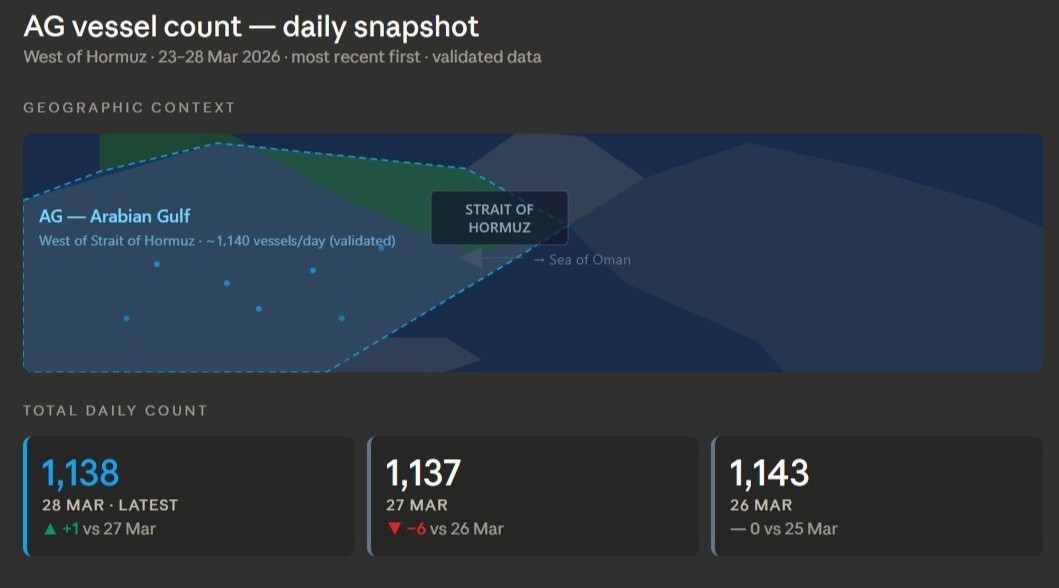
Strait of Hormuz AIS snapshot showing over 1,100 vessels, highlighting sustained congestion as transit remains restricted. (Source: Daejin Lee, LinkedIn, March 2026)
What happens when Strait traffic resumes?
A question we are hearing from members is what happens when Strait traffic resumes. The short answer: it will take time. The backlog of approximately 3,200 vessels will not clear quickly. Even at pre-conflict transit rates of 135 vessels per day, the queue alone represents weeks of throughput before normal commercial flows can resume. Berthing capacity, pilotage availability, and container equipment shortages are likely to compound delays. We strongly advise members to begin planning arrival sequences and coordinating with port authorities and marine service providers now, rather than waiting for a resumption announcement.
Guidance to Members
All guidance issued in our advisories of 4 March and 15 March, including BMP implementation, VHF Channel 16 monitoring, 30-nautical-mile standoff from naval units, charterparty war risk clause review, and GNSS reliability precautions, remains in full effect. In addition, the Association urges members to:
1. Assess implications of Iran’s transit system
Members considering seeking IRGC approval for Strait transit should take independent legal advice on the potential sanctions, compliance, and reputational risks involved. The Association is not in a position to advise on participation in this system.
2. Factor war risk insurance costs into all voyage planning
Premiums have surged from pre-conflict levels of 0.15–0.25% of hull value to as high as 5–10% per transit. Coverage remains available but at levels that are commercially prohibitive for most operators. Members should engage directly with their brokers and underwriters before committing to any Gulf-related voyages.
3. Plan for port congestion when traffic resumes
As detailed in the Strait of Hormuz section above, the vessel backlog will take weeks to clear. Early coordination with port authorities and marine service providers is strongly advised.
4. Report any unidentified floating objects to UKMTO immediately
The mine threat remains a concern. Continue to rely exclusively on UKMTO, MSCIO, and NAVCENT for verified maritime security information.
Looking Ahead
Emirates Shipping Association stands with the UAE’s leadership and the international community in demanding the protection of commercial shipping and the restoration of freedom of navigation in the Strait of Hormuz. We reaffirm our full support for the government’s position on the protection of national sovereignty and the safety of all who live and work in this country.
We have received valuable feedback from members on our previous advisories, and we are grateful for the engagement. If you have operational data, market insights, or on-the-ground intelligence that could benefit the wider membership, or if you would simply like to open a dialogue on how the current situation is affecting your operations, we welcome you to reach out to the Association Secretariat at info@7emirates.com. The Association’s Annual General Meeting on 16 April will include a dedicated session on the Gulf maritime crisis, its impact on members, and the path forward.
This advisory is issued for informational purposes and does not constitute legal, insurance, or operational advice. Members are advised to consult their own legal, insurance, and security advisors regarding specific voyage and operational decisions.
Sources:
AFP via Yahoo Finance, Strait of Hormuz Shipping Blockade Update, 31 March 2026 uk.finance.yahoo.com/news/facts-strait-hormuz-shipping-blockade-120842968.html
Al Jazeera, Tehran’s Toll Booth: How Iran Picks Who to Let Through Strait of Hormuz
aljazeera.com/news/2026/3/26/tehranstollbooth-how-iran-picks-who-to-let-through-strait-of-hormuz
Al Jazeera, Iran Says Non-Hostile Ships Can Pass Safely Through Strait of Hormuz
aljazeera.com/economy/2026/3/25/iran-says-non-hostile-ships-can-pass-safely-through-strait-of-hormuz
CNBC, Traffic Is Trickling Through Strait of Hormuz
cnbc.com/2026/03/18/hormuz-bottleneck-vessel-tanker-tracker-shipping-strait-of-hormuz.html
CNN, Mines, Missiles and Miles of Coastline: Why Iran Has the Upper Hand
cnn.com/2026/03/26/middleeast/how-iran-controls-strait-of-hormuz-explained-intl-vis
Euronews, Ships Seek Iranian Clearance to Cross Hormuz
euronews.com/business/2026/03/26/ships-seek-irans-clearance-to-cross-hormuz-as-risks-rise-and-insurance-costs-surge
Financial Times, How Iran Is Seeking to Cash In on the Strait of Hormuz, 27 March 2026
www.ft.com/content/cde4af2e-8ef3-422a-9197-325dac194190
Financial Times, Iran Conflict Turns Shipping Market Into ‘Wild West’, 18 March 2026
www.ft.com/content/69f0f8a4-2567-44f4-a7b7-6ce4c62ab0e2
Financial Times, Ships Forgo Cargo to Carry Fuel as Iran War Sends Prices Soaring, 27 March 2026
www.ft.com/content/44c0b1bf-f8aa-459f-bc2e-69b5a3a733e8
Financial Times, UAE Pushes for International Force to Reopen Hormuz, 27 March 2026
www.ft.com/content/aeb1cf6c-edde-486e-b437-94bbd4437912
GAC Hot Port News, Update on the Middle East Situation
gac.com/hot-port-news/update-on-the-middle-east-situation
gCaptain, UN Shipping Agency Says 3,200 Ships Trapped West of Hormuz
gcaptain.com/un-shipping-agency-says-3200-ships-trapped-west-of-hormuz-as-emergency-council-meeting-called
Gulf Today, UAE Advances as Global Maritime Power
gulftoday.ae/business/2025/06/22/uae-advances-as-global-maritime-power-through-system-of-legislation-investments
Gulf Business, Hormuz Traffic Collapse: 181 Ships Recorded in March
gulfbusiness.com/en/2026/trade/strait-of-hormuz-traffic-181-ships-march-70-percent-iranian
ICS, Statements on Seafarer Welfare and Gulf Crisis
ics-shipping.org
IMO, Secretary-General Statement on Seafarer Deaths
imo.org/en/mediacentre/pressbriefings/pages/imo-secretary-general-statement-strait-of-hormuz-seafarer-deaths-unacceptable.aspx
Inchcape Shipping Services, Middle East Port Operations Update
iss-shipping.com/advisories/middle-east-port-operations-update/
Lloyd’s List, Middle East Port Update, 27 March 2026
lloydslist.com/LL1156739
Lloyd’s List, Iran’s Toll Booth System in the Strait of Hormuz
lloydslist.com/LL1156720/Tehrans-toll-booth-system-is-now-controlling-Hormuz-traffic
Logistics Middle East, DP World Confirms Jebel Ali Port Is Fully Operational
logisticsmiddleeast.com/news/dp-world-has-confirmed-jebel-ali-port-is-fully-operational
Maritime Gateway, DP World Activates Land Corridors to Keep Jebel Ali Cargo Moving
maritimegateway.com/dp-world-activates-land-corridors-to-keep-jebel-ali-cargo-moving-amid-gulf-disruptions/
Rigzone, UAE Port Ramps Up Hormuz-Dodging Oil Flows, 27 March 2026
rigzone.com/news/wire/uae_port_ramps_up_hormuzdodging_oil_flows-27-mar-2026-183318-article
UAE Ministry of Economy, GDP Growth First Nine Months 2024
moet.gov.ae/en/-/uae-gdp-sees-3.8-per-cent-growth-in-first-nine-months-of-2024
UAE National Emergency Crisis and Disaster Management Authority (NECDA)
wam.ae
Press Enquiries
For media enquiries, interview requests or further information on this topic, the Association's communications team is available to assist.