Emirates Shipping Association
Insurance: A View from the Market


This article is part of Beyond the Strait — a thought leadership series from Emirates Shipping Association exploring the dimensions of the recent Arabian Gulf disruption. The series covers five themes: Human Factors, Legal, Insurance, Operational, and Commercial.
When the Strait of Hormuz disruption began on 28 February 2026, the maritime insurance market found itself managing approximately three billion US dollars of exposed assets in the region. War risk premiums rose. Capacity was tested. Coverage terms tightened, particularly around blocking and trapping. And through it all, the fundamental infrastructure that supports maritime trade in a crisis held.
The story is not only one of technical response under pressure. It is also one of a market that has learned from the disruptions that came before — COVID-19, the Red Sea incidents, the Russia-Ukraine conflict — and applied those lessons in real time. Insurance is a critical pillar of maritime resilience, and the past four months have illustrated both the strength of that pillar and the preparation that stands behind it.
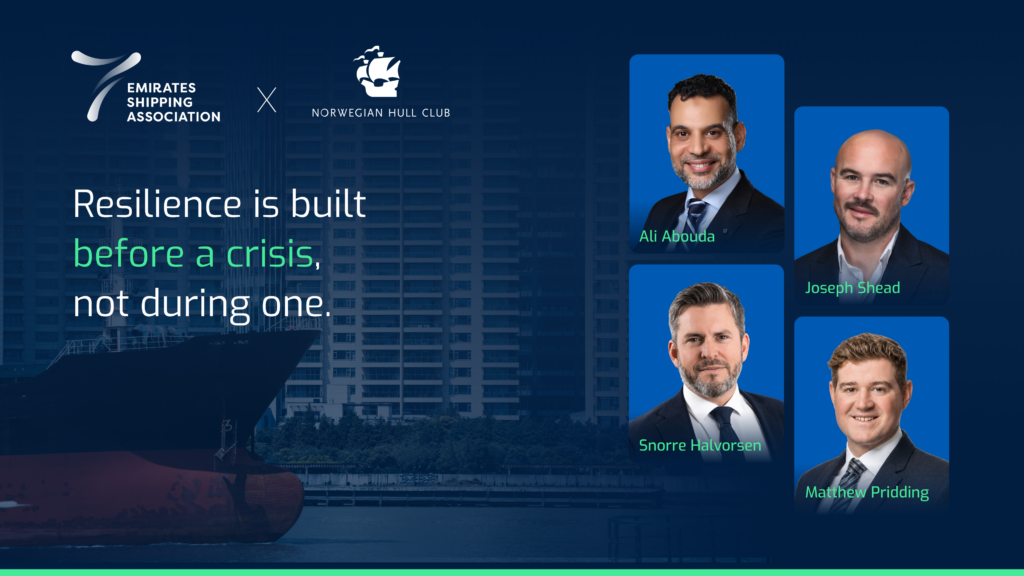
This article draws on a conversation with three specialists from Norwegian Hull Club: Matthew Pridding, Underwriter; Snorre Halvorsen, Senior Advisor, Loss Prevention & Emergency Response; and Joseph Shead, Legal Advisor. The discussion, moderated by Ali Abouda, Consultant at Emirates Shipping Association, examined the insurance response to the disruption from underwriting, claims, and legal perspectives.
The Insurers’ Role
Norwegian Hull Club is a mutual hull insurer that leads approximately 60 per cent of the business it writes and handles around 3,000 claims annually. What distinguishes its approach is the emphasis placed on client relationships and loss prevention long before any claim arises.
The Club’s service concept, which Snorre Halvorsen describes as preparedness by awareness, is built around a structured programme of emerging risk studies, voyage risk assessments, and emergency response training delivered at both operational and strategic levels. Its live exercises use its own staff to simulate media, authorities, and other stakeholders — stress-testing clients’ crisis response frameworks in a safe environment before real events can test them.
“We like to cause a sound paranoia. We look at the different types of risks around the world. We study cases. And this is something we like to share — because it’s our core value to share knowledge on what to do and what not to do.” — Snorre Halvorsen, Senior Advisor, Loss Prevention & Emergency Response, Norwegian Hull Club
Over the past four months, that infrastructure was tested in the Arabian Gulf at scale — from the immediate risk assessments required as the disruption began, to the sustained support of clients whose vessels were trading in and around the region.
What War Cover Actually Is
At a technical level, war insurance covers a specific set of perils that are excluded under a standard marine hull policy — mines, torpedoes, rockets, missiles, and similar risks arising from armed conflict. A shipowner buys an annual policy that provides worldwide cover, with the exception of listed geographical areas. To trade in a listed area, the owner buys additional cover from their underwriter for the period concerned.
Historically, this structure has proven adaptable. When the Strait of Hormuz was closed in late February, the immediate concern for underwriters was blocking and trapping — the risk that a vessel becomes stuck in a limited geographical area and cannot leave.
“The first and foremost is a vessel becoming stuck in a particular waterway so that it is of no use to you as an owner. Deprivation of possession. That can mean that after a certain period, effectively you’ve lost that ship — you’ve lost free use and disposal of that ship for long enough to trigger a claim under your policy.” — Joseph Shead, Legal Advisor, Norwegian Hull Club
The Arabian Gulf disruption presented a distinct challenge relative to earlier conflicts. In the case of Russia and Ukraine, the position on maritime traffic through affected corridors was relatively stable and well-understood. The situation in the Gulf, by contrast, evolved daily — with information moving through both official and informal channels, sometimes contradicting itself, and often reaching vessels via social media before it reached them from company headquarters.
“The situation within the Gulf is quite different in terms of how it’s reported and how news reports it. That makes trying to ascertain the facts quite difficult. In that respect, close communication between our members, insurers, and brokers is very important — sharing situational awareness and, where possible, sharing intelligence.” — Joseph Shead
The lesson is a practical one. In a modern disruption, information hygiene is itself a risk management discipline. The market’s ability to respond effectively depends on close communication between owners, brokers, and insurers, and on shared situational awareness across the network.
The Wider Risk Picture
Something easily missed when attention is focused on war risk: standard maritime risks do not disappear during a conflict. They tend to become more acute.
“The usual maritime risks continue to be in play. Ships colliding with each other, machinery breakdowns whilst you’re stuck within the Gulf. Those risks can become more enhanced as a result of the location of a vessel. Reduced repair options and facilities. Crew becoming fatigued, tired, overworked, or feeling stressed. Being in a conflict area is only going to heighten those types of things.” — Joseph Shead
The point matters practically. A vessel operating in a heightened-risk zone is more likely to experience mechanical issues, has fewer options for maintenance and repair, and is often crewed by seafarers under considerably more strain than usual. Insurance policies respond to these secondary risks under marine hull rather than war cover, but the underlying operational picture demands attention from both directions.
Cyber and navigational risks add another dimension. Reports of GPS spoofing, signal manipulation, and cyber interference — some of which have surfaced during the Gulf disruption — can affect multiple vessels remotely, and depending on the circumstances may fall under either marine or war coverage.
The Human Element in War Cover
An aspect of war insurance that is less widely understood: unlike standard hull cover, war policies typically include an element of protection and indemnity. Crew care sits inside the war cover rather than being handled separately by a P&I club.
The practical implication is that in the aftermath of an attack, a near miss, or a difficult transit, the war insurer is often the first party involved in managing the human consequences — repatriation, psychological support, and the wider welfare of the crew.
“When it comes to war insurance, there is an element of crew care within it. Many insurers aren’t used to dealing with that, and are suddenly thrown into a situation — maybe following an attack, a near miss on a ship, and the crew are understandably frightened. Dealing with that requires a very different set of skills and contacts than perhaps dealing with a normal hull or machinery claim.” — Joseph Shead
What Norwegian Hull Club has found over years of managing such situations is that the operational and human dimensions of a claim are directly linked.
“By supporting a crew in these difficult times, actually the outcome for the assets improves. Because the crew want to help. So it’s humans first — but it plays an important part of the overall matrix of the claim.” — Joseph Shead
The observation aligns with a broader shift underway across the maritime workforce: increasing recognition that crew welfare is not a soft variable but a core operational input, and one that insurance markets are increasingly structured to support.
A Market That Held
The performance of the insurance market during the Gulf disruption is best understood in the context of what came before it. The COVID-19 crew change crisis, the Red Sea incidents, and the Russia-Ukraine conflict each tested different aspects of the market’s response capability, and each provided lessons that shaped how the industry positioned itself for the events of the past four months.
“With Russia-Ukraine, insurers on the whole were quick to pay the total losses after the year, supporting their owners in that way. We’re a forward-thinking market. Obviously you don’t know these things are around the corner — and when they come, you have to react to them.” — Matthew Pridding, Underwriter, Norwegian Hull Club
An early narrative during the Gulf disruption — one that circulated widely in the maritime press — was that insurers were withdrawing cover en masse. The reality, from the market’s perspective, was more measured.
“The insurance market was unfairly portrayed at the start of the conflict. There was talk of cover being pulled and cancelled. The cover was cancelled — but then reinstated immediately, according to the clauses representing the new risk. It wasn’t insurers pulling the drawbridge up and running away. It’s an agreed contract with agreed clauses. You reassess the new risk and continue to support your clients.” — Matthew
The important nuance is that reassessment and repricing are not the same as retreat. Rates rose meaningfully for vessels trading in and around the region, and terms tightened around blocking and trapping in particular. But capacity remained available, and the market continued to write the business.
Longer-tail risks — machinery issues arising from extended idle periods, corrosion, deferred maintenance under supply chain constraints — are still working their way through. These are not yet fully visible in claims data but will shape the market’s view of the disruption for some time.
Regional Resilience as a Risk Factor
One of the more useful observations from the panel concerned the operational resilience of specific hubs within the region — and how that resilience shapes underwriting decisions in ways that are often not appreciated at the strategic level.
Throughout the disruption, UAE ports and their associated marine services remained fully operational. Bunkering, crew change, and maintenance continued. From an underwriting perspective, this changes the risk profile of vessels that operate primarily within the region — as distinct from vessels that transit through it.
“Vessels that trade within the Gulf generally, and don’t tend to leave — that risk profile is very different from vessels that would like to transit frequently. The strategic risk is always there, as the situation is now. But there’s also the local resilience of the hubs. It’s case by case.” — Joseph Shead
The observation has practical implications. Owners and operators whose fleets are structured around a strong regional hub are, in insurance terms, holding a different asset than those exposed to the wider strategic risk of the checkpoint itself. This is one of the ways in which operational decisions taken in advance of a crisis materially affect insurance outcomes when a crisis arrives.
The Long View: Total Loss and Reopening
Two technical points from the discussion are worth surfacing for the broader market.
The first is how prolonged detention is treated under standard policies. Historic wordings often included six-month or twelve-month triggers for constructive total loss. Today, twelve months is the market standard — a continuous period during which a vessel physically cannot leave, at which point underwriters begin looking closely at total loss implications. The current environment has pushed some clauses tighter still: underwriters have quoted eighteen-month detention triggers for vessels entering the Arabian Gulf in recent months.
The takeaway is that owners are best served reading their policy wordings carefully now — before a scenario develops — rather than after.
The second point concerns the reopening. There is a natural focus on the closure risk, but the reopening — the moment when many vessels attempt to transit simultaneously — carries its own hazards.
“When it opens, you will have seafarers that are tired, fatigued. You have a stampede that has been used as a word — going out or in from the same spot. It’s about the pressure that is coming, the schedule and the regime. Hopefully it is timely, so that you don’t get concentration risk in that area.” — Snorre Halvorsen
The risks are practical: collision, pollution, salvage complexity when multiple casualties occur in a limited waterway. The mitigation is coordination — between authorities, owners, and the wider market — and continued vigilance from crews and operators during what can otherwise feel like a return to normal.
In Closing
If a single lesson emerges from the panel, it is one that insurance professionals often repeat but that the wider industry sometimes forgets in calmer periods.
“The biggest lesson for ship owners is that resilience is built before a crisis, not during one.”
Insurance is a critical pillar of that resilience, but only a pillar. It sits alongside operational preparedness, crew welfare infrastructure, information discipline, and stakeholder communication — the wider ecosystem that determines how effectively a company navigates a major disruption.
The Arabian Gulf disruption tested every part of the maritime system. Insurance markets held. Underwriting capacity remained available. Claims were managed. Crew care sat inside the response rather than adjacent to it. And the relationships built up between owners, brokers, and insurers over years of quieter operations were the infrastructure that made that response possible.
The recovery phase now underway is an opportunity to apply what has been learned, and to continue strengthening the systems that support the industry through the disruptions that will inevitably come next.
Watch the full panel discussion below:
Press Enquiries
For media enquiries, interview requests or further information on this topic, the Association's communications team is available to assist.